Begin these neck strain exercises as soon as tolerated. Avoid any movement that increases your pain — progress at your own pace.
A neck strain occurs when the muscles or tendons supporting the cervical spine are overstretched or torn — commonly from sudden impact, poor posture, or repetitive strain. The following exercises are recommended by our physiatrists at Advanced Sports & Spine in Charlotte, NC to restore range of motion, reduce pain, and strengthen the surrounding musculature. If any exercise causes sharp or radiating pain, stop immediately and contact our office.
Place your fingers on your chin and gently push straight back, creating a double chin. Keep your eyes forward as your head moves back. Hold for 5 seconds then relax. Repeat 10 times. This exercise retrains cervical alignment and relieves compression from forward head posture — one of the most common contributors to neck strain.

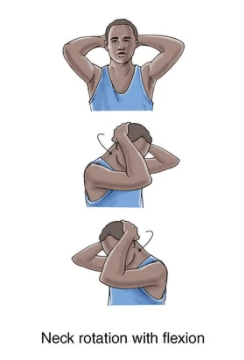
Turn your head to the right and clasp your hands behind your head. Allow the weight of your arms to gently pull your chin toward your chest. Relax and hold for 15 seconds. Repeat 3 times on each side. This movement restores rotational mobility and gently lengthens the posterior cervical muscles tightened by strain.
Turn your neck to look over your right shoulder. Place your right palm against the left side of your chin and apply gentle pressure toward your right shoulder. Hold for 10 seconds. Complete 3 repetitions on each side. This stretch targets the sternocleidomastoid and upper trapezius — the muscles most commonly involved in neck strain injuries.


Sit upright with your hands clasped behind your back. Lower your left shoulder and tilt your head to the right. Hold for 15–30 seconds, then return to the starting position. Repeat on the other side. Complete 3 repetitions per side. The scalene muscles attach the neck to the ribs — stretching them reduces tension that contributes to persistent neck strain pain.
Sit or stand with your arms at your sides. Squeeze your shoulder blades together as if trying to hold a pencil between them. Hold for 5 seconds, then release. Repeat 10 times. Strengthening the scapular stabilizers reduces the compensatory load placed on the cervical muscles during daily activity — a key step in long-term neck strain recovery.


Sit in a chair and place your hands behind your head. Gently lean back over the top of the chair, extending your upper back into extension. Hold for 3–5 seconds and return upright. Repeat 5–10 times. Thoracic stiffness is frequently the underlying cause of recurrent neck strain — mobilizing the mid-back reduces the compensatory strain placed on cervical structures.
Most mild to moderate neck strains resolve within 4–6 weeks with consistent rehabilitation. Severe strains involving significant muscle or tendon tearing may take 3 months or longer. Our physiatrists at Advanced Sports & Spine in Charlotte, NC will assess your injury and develop a recovery timeline specific to your condition.
Seek medical attention if your neck pain is accompanied by radiating pain or numbness into the arms, weakness in the hands, severe headache, or if symptoms do not improve after 1–2 weeks of rest and home exercise. These may indicate a more serious cervical injury requiring clinical evaluation.
Yes — these exercises are appropriate for mild to moderate whiplash injuries as well as muscle strain. Begin gently and only progress to the full range of motion as pain allows. If you were involved in a motor vehicle accident, we recommend an evaluation before beginning any exercise program.
Beyond home exercise, our Charlotte physiatrists offer trigger point injections, cervical epidural steroid injections, PRP therapy, and comprehensive non-surgical pain management for neck strain that does not respond to conservative care. Call 704-542-3988 to schedule an evaluation.
Call us at 704-542-3988 or use our online appointment form.
Book Appointment